



We live on poisoned land, in bodies filled with plastics and chemicals such as PFAS. How can we live and find love and solidarity amidst these ruins? In this Autumn Issue, Luca Hopman and Marguerite van den Berg aim to learn from foremothers and contemporary heroines and set out to find the courage to protect each other.
‘You sleepwalk for centuries and you don’t look around
At the progress of man, determined and bound
We live in the ruins of another life’s dream
But nobody told us that we all live downstream’
Bonnie Prince Billy – Downstream
What was long called ‘progress’ has often turned out to be destruction. Bonnie Prince Billy captures this most beautifully perhaps: ‘we live in the ruins of another life’s dream’. The dream of progress, control and prosperity brought us land that is poisoned, toxic, exhausted. Harmed animals, species that have gone extinct. PFAS and plastics in our blood. These bits of debris are impossible to clear up, like perhaps ruins of stone would be. These are chemical ruins. Much of it is here to stay. In rivers, in the ground, in our bodies.
We all live downstream, sings Bonnie Prince Billy. The toxins will reach us too.
It takes courage to see this truth.
There is a commercial from 1947 for DDT. A dog, an apple, a potato, a cow, a rooster and a housewife sing ‘DDT is good for me-e-e!’
The insecticide DDT was a solution, back in 1947. Literally, of course: a chemical solution. But also metaphorically: DDT promised to solve problems. Scientists worked towards a green revolution. Food provisioning would become far more efficient, farming would become possible without pests, illnesses would be cured or banned, the economy would grow and finally everyone would prosper, so soon after World War II. A dream of progress. Another life’s dream.
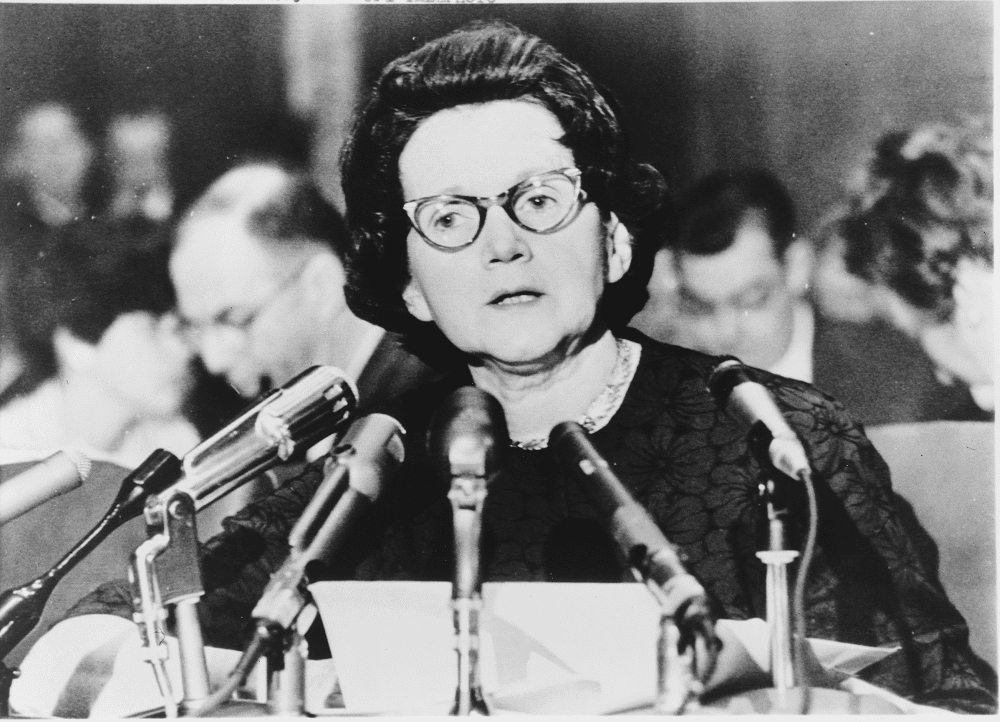
When Rachel Carson published her bestselling Silent Spring in 1962 she was already a famous American author, who wrote three books about the oceans and seas. With Silent Spring, she introduced a large audience to the disastrous effects of the widespread use of pesticides. It was a book with serious impact; it was an impulse for the environmental movement. DDT, one of the insecticides she wrote against, was banned. Of course, DDT was not ‘good for me-e-e’, but poisonous and harmful.
Carson describes with great precision how insecticides became widespread after World War II. In twenty years, she maintains, nature and soil were disastrously contaminated. Some insecticides were indeed developed earlier in the twentieth century as chemical weapons. The stuff designed to be used in warfare was especially efficient in killing insects and other small animals in what Carson calls a ‘war against nature’. Other materials were used too: planes and trucks built for the war were used to spray DDT and other pesticides on farm land, suburbs, homes.
There were places where all the birds died. Places where certain insects became dominant because their predators were killed. Places where the roadside became a brown mush. A woman died of leukaemia, months after she had sprayed her basement with insecticides for fear of spiders and going into her basement immediately after. Silent Springis full of such stories, Carson presents much evidence.
The book started with a letter from a friend. Olga Huckins had seen birds fall dead on her land after a plane had sprayed DDT. As she writes to Carson and to The Boston Herald: ‘a small world (was) made lifeless’. Huckins asked Carson to help and the image of a Spring season without birdsong moved Carson to write Silent Spring.
Because Carson never became a scientist at an institute or university, she was at liberty to do so. As a woman, she was never hired at a university or admitted for a PhD programme and so remained a relative outsider. Perhaps it was better this way. The most important work is often done from the margins. Our academic colleagues often turned out to be in the pockets of industry, Carson shows. They were often paid by chemical industries and enrolled in its projects and did not investigate the harmful effects of the toxins. That is something we may take to heart at a time when universities are competing to work with industry and defence departments for ‘impact’.
Besides this entanglement of scholarship and industry, Carson also critiqued deeply held faiths in progress and control of nature. Pesticides allow humans the power to reduce the complexity of ecosystems with violence. Nature is simplified in the process: only allowed to perform a single task, for example growing one particular crop. This meant that all other life in the complex system became a hindrance, something to combat. The fiction that this was progress had disastrous consequences. Carson was not the first to say or write this. Indigenous peoples had warned before Carson but were not listened to. A contemporary indigenous writer who speaks out about farming and insecticides is Robin Wall Kimmerer. She demonstrates beautifully that it is precisely the disentanglement of species that renders them vulnerable.
Silent Spring is incredibly detailed and quite dry in explaining the hubris of insecticides. How toxins travelled to land that was kilometres away, through wind or by water. These toxins also react to each other of course, in the water and in our bodies. To scientists, much of these effects and long-term health impacts were unknown.
Carson is a foremother in a long line of courageous activists that have struggled and are struggling against the use of pesticides. This is still necessary. DDT is banned in many countries (though not all) but many toxins still are not. In July 2025, Le Monde headlined: ‘Meet the face of France’s anger against cancer and pesticides’. The article shows Fleur Breteau, a cancer patient herself, as the face of a social movement that fights the introduction of the Duplomb law. The law reintroduces a pesticide that is harmful to bees, after it was banned in 2020. The Netherlands, the place from which we write here, is record holder of European countries: it is among the nations where the most pesticides per hectare are used. Breteau is furious about this and founded Cancer Colère: Cancer anger. Furious, because of the ‘tsunami’ (as the director of a large oncological centre calls it) of women and young children with cancer that she met during her treatments. Enraged, because of the callousness of reintroducing this poison in our lives, because of how big pharma makes money. The movement Cancer Colère refuses to be silent; the organizers and protesters show us that having cancer is not a personal, individual drama, but a public issue – living downstream from another life’s dream.
Fleur Breteau shows us her vulnerability. Whether she became sick because of pesticides is impossible to determine. But the fact that these pesticides cause cancer is clear. She shows us what this means: her body thin, her hair gone. She shows the effects of the illness and treatment without shame. Look. This is what pesticides do to us.
It takes courage to show such vulnerability.
The writer and poet Audre Lorde wrote about her experiences with cancer in the 1980s. She too found it important to make her body, her suffering public. Forced to face her mortality, looking back at her life, she realized that she had regretted the moments of silence the most. Silences that allow violence to continue. In much of her writing she speaks out to break through structures of racism and sexism, structures that thrive in silence. Lorde writes about the fear of speaking out, of transforming silence in language and action, making oneself hyper-visible. So many responses are possible: ridicule, criticism, violence. We have only to look at how industry responded to Carson’s book: armies of men in white coats and suits, fully funded in laboratories and offices put money and energy in an ugly campaign to discredit Carson. The campaign had little effect on her. Carson suffered from cancer herself by this time and died two years after publishing Silent Spring.
Industry would rather not have us expose what their toxins bring us. But perhaps we are also afraid ourselves, afraid of the visibility of our vulnerability, writes Lorde. She knew this before she became sick. She had had to expose herself again and again, expose the parts of her that made her most vulnerable. As an activist. As a Black woman. As a lesbian woman. But precisely the visibility of our vulnerability is also our greatest strength, she writes. The fear will stay whether we remain silent or not: “We can sit in our corners mute forever while our sisters and our selves are wasted, while our children are distorted and destroyed, while our earth is poisoned, we can sit in our safe corners mute as bottles, and we still will be no less afraid” (p. 15). Lorde died from cancer in 1992.
We must break the silence and act. But not on our own. Lorde writes that every time she found words and spoke out, she met other women with whom she searched (the words for) a world in which they could all believe. They made futures for us. Fleur Breteau shares in this experience. Her movement breaks a silence out of anger. The Duplomb law was challenged publicly and ultimately even stopped in the Constitutional Council. There is a power in anger that makes new futures possible. Yes, there are too many toxins in our environment and in our bodies, toxins that will likely never fully disappear. Carson was unable to stop it all. But she, and the activists that took on her call, did give us a ban on DDT and they saved lives and ecosystems. Her courage did not save us from all ruination. But it did save us from DDT.
Carson struggles quite a bit in Silent Spring too. On the one hand, she aims to show us what is wrong with the modern human desire for control, that there is a natural balance that we should not disrupt. But ultimately, she does want to intervene – only with biological solutions, for example by using the natural predators to combat unwanted species. She even goes as far as celebrating an experiment where biological measures were used on Curaçao – A Dutch colony. Distributing sterilized screw worms were a successful intervention against the total population of screw worms there. Carson looks for an answer, a way to show us that things can be done differently. In doing so, she falls back on a logic in which a colonized territory is at the disposal of science, without saying a word about the inhabitants or ecologies there – a limitation that should be placed in her time and in the context of her whiteness, but one that should be regarded critically now.
Sometimes we cannot yet name, we learn from Lorde. But of course, we know that something is wrong when trees and animals die. When there is no birdsong. When people around you suffer from cancer. There are so many silences to break.
We live in the ruins of another life’s dream – it’s true. And this ruination is in our bodies. But what Rachel Carson, Audre Lorde and Fleur Breteau teach us, is that there is still something to protect. We can give each other the courage to speak, to let ourselves be seen and to protect others by doing so. Rachel Carson fought a powerful industry and stopped DDT. Audre Lorde let us see her, found the right words, found others and protected us. Fleur Breteau shows us the ruination of her body, lets us experience our vulnerability. She fights for public health, mobilized others, ultimately to protect us all. This is feminist love.
Floor Bouma, 2025. Met haar Franse actiegroep Kankerwoede strijdt Fleur Breteau tegen pesticiden en kortzichtige politici. NRC Handelsblad, August 6, 2025.
Rachel Carson, 1962. Silent Spring, with an introduction by Linda Lear. Mariner Classics.
Robin Wall Kimmerer. 2013. Braiding Sweetgrass. Indigenous Wisdom, Scientific Knowledge and the Teaching of Plants. Penguin Books.
Audre Lorde, 2020. The Cancer Journals. Penguin Classics. (First publication 1980)
Le Monde, July 22, 2025. Meet the face of France’s anger against cancer and pesticides. Hier te vinden:https://www.lemonde.fr/en/environment/article/2025/07/22/meet-the-face-of-france-s-anger-against-cancer-and-pesticides_6743595_114.html
This episode of our feminist love letters comprises a correspondence between Anja Meulenbelt, Marguerite van den Berg, and Noortje van Amsterdam. We wrote the letters in the summer and fall of 2025, a moment when violence against women and femicide were hotly debated in the Netherlands, like they are presently and recurringly. Noortje and Marguerite initiated a conversation with Anja because she is, for many different reasons, their feminist foremother. A conversation on shame, existential fear and feminist love.
Translation from Dutch to English: Noortje van Amsterdam
Only by becoming disloyal to this world am I able to remain alive and human. Zakia Essanhaji wrote a love letter to those that try to remain alive, hopeful and human in a world that insists on death, destruction and dehumanization.
Feminists have had to confront sexual violence head-on. With courage and pugnacity, they politicised individual tragedies and turned them into a collective experience to be reckoned with. Massilia Ourabah expresses her feminist gratitude, and asks men: We did Me Too, how about Your Turn?
Noortje van Amsterdam paints the sky from her home. She is looking for crip solidarity: "My wish is for us (yes, together!) to reach for the sky in order to build networks where we can rehearse crip solidarity as a reformulation of our relationships with our workplaces, our own bodies, and those of others."